


King
Administrator
- Joined
- Jul 12, 2021
- Messages
- 25,005
- Reaction score
- 5
- Points
- 38
MP4 |Video: h264, yuv420p, 1920x1080 | Audio: aac, 48000 Hz | Duration: 59m | 136 MB
Genre: eLearning | Language: English
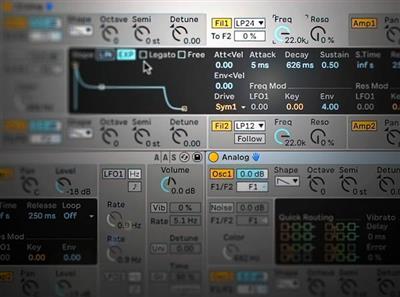
In this Ableton Live Analog video course, DAW guru Larry Holcombe demonstrates how it's possible to achieve the golden analog synth tones of yesteryear in virtual form, thanks to the impressive virtual instrument Analog. You'll also learn much about the basics of synthesis in the process as well, incase you're still a bit unsure of how they work - information that can also be applied to other virtual synths, or hardware synths should you find yourself with one. These videos are for new Ableton Live Analog users.
Larry begins by introducing the plugin and giving you a tour of the interface, so you're aware of the signal flow and basic control layout. This will help you to understand why and how signals are created, modulated, and more. The oscillator section is covered next, where you'll learn how to generate various timbres via different waveforms and also how to create those signature, thick synth tones by applying detuning. Then, discover how the noise generator can be used to synthesize various drum/percussion sounds and/or add grit to other sounds.
Next, explore the filter section and envelopes, both of which contribute greatly to a synth's sound. Learn how envelopes allow you to change the tone over time, with the filter envelope used as an example. Larry then demonstrates the amplifier section, which regulates a sound's volume over time. Learn also how to create auto-pan and tremolo effects in the process.
Beyond that, you'll also learn about the LFO section (how to route it to other sections to modulate the signal) and global parameters (unison, glide, polyphony, etc.), and you'll close out by hearing Larry create a basic loop of percussion, pads, and bass using nothing but Ableton Live Analog!
With Ableton Live Analog, you don't...
Read more
Continue reading...