


King
Administrator
- Joined
- Jul 12, 2021
- Messages
- 25,005
- Reaction score
- 5
- Points
- 38
Published 11/2022
MP4 | Video: h264, 1280x720 | Audio: AAC, 44.1 KHz
Language: English | Size: 1.71 GB | Duration: 2h 18m
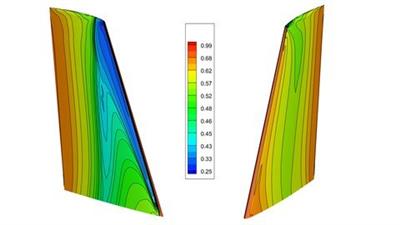
CFD analysis of ONERA M6 wing using Fluent and validation with AGARD experimental data and high quality CFD from NASA
What you'll learn
To conduct CFD analysis of ONERA M6 wing in particular and CFD analysis of any wing or aerodynamic body in general
How to get high quality data from literature for validation
Understanding drag, lift and pitching moment coefficient and reference values
Setting up problem in Fluent and accelerating convergence
Effect of turbulence model and Y+ values on aerodynamic coefficient
Validating present CFD with avaiable experimental data and high quality CFD from NASA
Effect of different solvers on results
Requirements
Basic understanding of aerodynamics and CFD
Should be able to use Fluent on basic level
Computer with i3 or better processor and 8 GB RAM. 16 GB RAM is recommended
ANSYS 2022 R1 installed on your computer
Description
In this course you will learn about CFD analysis of ONERA M6 wing. First we will go through problem descriptions and given operating conditions. After that we will discuss about the different aerodynamic coefficients such as lift coefficient and reference conditions. I will also explain that how to calculate reference area, pressure, density etc. from Reynolds number and Mach number. We will then discuss about the experimental data for Cp plots. We will then go through different literature to explore the CD, CL and CM as these are not given in experimental work by AGARD published in 1979. But fortunately NASA has published high quality CFD data for Cp and CL, CD and CM for different solvers and mesh types. Therefore we will use NASA data to compare drag, lift and pitching moment coefficients. After this all discussion we will import mesh into Fluent. Mesh is...
Read more
Continue reading...