


King
Administrator
- Joined
- Jul 12, 2021
- Messages
- 25,005
- Reaction score
- 5
- Points
- 38
Published 11/2022
MP4 | Video: h264, 1280x720 | Audio: AAC, 44.1 KHz
Language: English | Size: 4.49 GB | Duration: 11h 35m
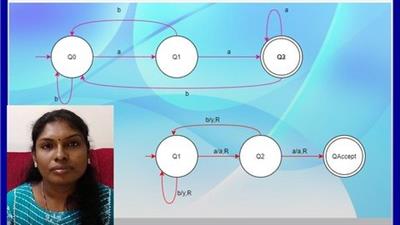
Theory of computation, Automata Theory, Formal Language and Automata Theory
What you'll learn
Understand the basics of Automata Theory, Languages and its need
Understand the working of Finite Automata, Push Down Automata and Turing Machine
Able to solve problems using Finite Automata, Push Down Automata and Turing Machine
Able to recognize the relationship between various Automata
Understand the need for proving various equivalence between Automata
Requirements
No prerequisites are there for this course. Students can listen to the lectures to understand Automata Theory concepts from base.
Description
The aim of this course "Introduction to Automata Theory, Languages and Computation" is to give a detailed working explanation regarding each Mathematical model, its corresponding languages, and their provable equivalence. "Theory of Computation" has three major subdivisions namely1) Automata Theory2) Computability Theory3) Complexity TheoryThe automata theory deals with some Mathematical models that perform some operations automatically like programming machines. There are four main Mathematical models namely, Finite Automata(FA), Push Down Automata(PDA), Linear Bound Automata(LBA), and Turing Machine(TM). Each Mathematical model differs based on its memory units as FA has no external memory unit, PDA has stack as a memory unit, LBA has finite length tape as a memory unit and TM has infinite tape as a memory unit.Based on the limitations in the memory unit each model solves a limited set of problems only. The set of problems solved by each model is grouped as languages accepted by the model. The problems solved by Finite Automata are called Regular Language and its corresponding language representation is called Regular...
Read more
Continue reading...