


King
Administrator
- Joined
- Jul 12, 2021
- Messages
- 25,005
- Reaction score
- 5
- Points
- 38
Last updated 5/2021
MP4 | Video: h264, 1280x720 | Audio: AAC, 44.1 KHz
Language: English | Size: 704.25 MB | Duration: 1h 45m
Overview of DAC Theory, Circuit and project flow
What you'll learn
Overview of DAC
Background and Principle of Operation
Implementation Aspects and Challenges
Evaluation Parameters
Expected Input Output Characteristics
Requirements
VSD - Circuit Design and SPICE simulations
VSD - Custom Layout
VSD Intern - Bandgap IP Design
Description
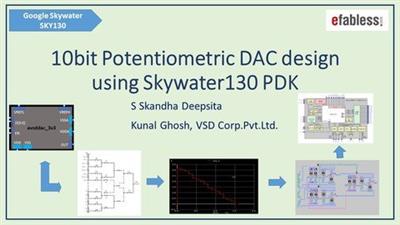
The webinar aims to design a 10-bit potentiometric Digital to Analog Converter using end-to-end Open-source EDA tools. The target is to design 10-bit potentiometric DAC with 3.3v analog voltage, 1.8v digital voltage and 1 off-chip external voltage reference using sky130nm technology node.In real world, most of the data available is in the form of analog in nature. We have two types of converters analog to digital converter and digital to analog converter. These two converting interfaces are essential to obtain the required operations of a processor to manipulate the data of digital electronic equipment and an analog electric equipment. Digital to Analog Converter (DAC) is a device that transforms digital data into an analog signal in order to interact with the real world. The digital signal is represented with a binary code, which is a combination of bits 0's and 1's. The digital data can be produced from a microprocessor, Field Programmable Gate Array (FPGA), or Application Specified Integrated Circuit (ASIC). There are two commonly used DAC conversions - Weighed resistors method and R-2R ladder network method. Applications of a DAC: audio amplifier, video encoder, display electronics, data acquisition systems, calibration, Digital potentiometer.This webinar will cover1) Overview of DACWhy DAC?Background and Principle of Operation.Implementation Aspects and Challenges.Evaluation...
Please Login or Register to view content
Continue reading...