


King
Administrator
- Joined
- Jul 12, 2021
- Messages
- 25,005
- Reaction score
- 5
- Points
- 38
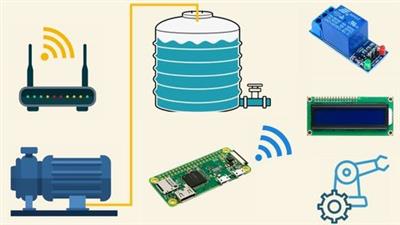
Complete Water Tank Automation Using Raspberry Pi
Published 11/2022
MP4 | Video: h264, 1920x1080 | Audio: AAC, 44.1 KHz
Language: English | Size: 1.31 GB | Duration: 2h 7m
Learn how to automate your motor pump and save water and energy using the mini Raspberry Pi
What you'll learn
We will get to know about the project concept and the problem which we are going to solve by developing this project.
Thereafter, we will cover the stepwise approach to be followed, so that the learning curve remains easier for the project development.
Going forward, we will understand the complete hardware requirements for the project development and its individual usage.
Then we will proceed to learn about Raspberry Pi and its detailed specification.
We will then came to know, how to download and burn the latest version of the operating system to the SD card and configure the Pi for its usage via SSH.
We will then learn how to assign a static IP address to the Raspberry Pi by making certain changes in the operating system files.
Thereafter, we will proceed with the update and upgrade of the software library packages.
We will then step into the world of physical computing and learn how to test the motor pump which we have purchased for the project development.
We will then learn about the working principle of the relay and test the functioning of the relay using our customized program.
We will then get to know about the distance measurement sensor and how to assemble the same with the Raspberry Pi.
Thereafter, we will understand the program using which we can measure the accurate distance between the object and the sensor.
Finally, we will test the last module of the project which is our LCD. We will first learn about the I2C detection and then programmed the LCD to print.
After testing all the modules, we will start the main project. We will follow a standard circuit...
Read more
Continue reading...