


King
Administrator
- Joined
- Jul 12, 2021
- Messages
- 25,005
- Reaction score
- 5
- Points
- 38
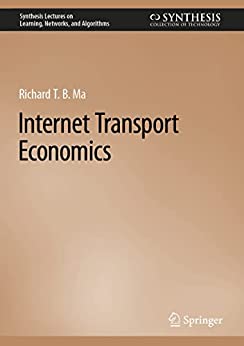
English | 2022 | ISBN: 3031144201 | 205 Pages | PDF EPUB (True) | 12 MB
This book presents Internet transport economics as a new approach to understanding the packet-switching paradigm of Internet infrastructure as a global transport system for data packets. It is a prescient view of the Internet's evolution into a content-centric service platform where the quality of services (QoS) cannot be guaranteed due to the tens of thousands of autonomous systems that enact business decisions on peering, routing, and pricing in a way that determines aspects of the Internet ecosystem like network topology, latency and throughput of traffic flows, and performance of network applications. The trafficking issues created in this environment are a critical concern and barrier for user applications that require real-time responses, such as telesurgery and teleoperation of autonomous vehicles, and the book presents the Internet transport economics model as the solution. While engineering and business are the prevailing lenses through which the Internet is viewed, the book builds its methodological framework around transport. Further delving into economics, it establishes how the Internet can be understood as providing transport services for data packets, whose demand and supply are driven by the QoS metrics of delay and loss, which can be regarded as congestion costs that result in equilibrium rates of traffic flows sent by content providers (CPs). The book goes on to present a stylized model of content provider-to-access provider (CP""AP) service as well as congestion equilibrium and rate equilibrium solution concepts under the Internet transport economics framework. These are used to analyze the problem domains of service differentiation, market structure, and data pricing. Finally, it discusses various potential future applications. This book will be of interest to graduate students...
Read more
Continue reading...