


King
Administrator
- Joined
- Jul 12, 2021
- Messages
- 25,005
- Reaction score
- 5
- Points
- 38
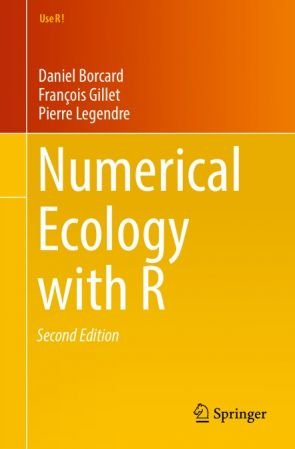
English | PDF,EPUB | 2018 | 444 Pages | ISBN : 3319714031 | 58.5 MB
This new edition of Numerical Ecology with R guides readers through an applied exploration of the major methods of multivariate data analysis, as seen through the eyes of three ecologists. It provides a bridge between a textbook of numerical ecology and the implementation of this discipline in the R language. The book begins by examining some exploratory approaches.
It proceeds logically with the construction of the key building blocks of most methods, i.e. association measures and matrices, and then submits example data to three families of approaches: clustering, ordination and canonical ordination. The last two chapters make use of these methods to explore important and contemporary issues in ecology: the analysis of spatial structures and of community diversity. The aims of methods thus range from descriptive to explanatory and predictive and encompass a wide variety of approaches that should provide readers with an extensive toolbox that can address a wide palette of questions arising in contemporary multivariate ecological analysis. The second edition of this book features a complete revision to the R code and offers improved procedures and more diverse applications of the major methods. It also highlights important changes in the methods and expands upon topics such as multiple correspondence analysis, principal response curves and co-correspondence analysis. New features include the study of relationships between species traits and the environment, and community diversity analysis.
This book is aimed at professional researchers, practitioners, graduate students and teachers in ecology, environmental science and engineering, and in related fields such as oceanography, molecular ecology, agriculture and soil science, who already have a background in general and multivariate statistics...
Please Login or Register to view content
Continue reading...